I know this issue is a day early, but it's Earth Day! Happy Earth Day Everyone! I bet you didn't know having an energy audit done on your home could save you up to $600 dollars a year. And it wouldn't even cost you a dime.
Giving credit to TIME,
I'd like to thank them for showing us the many ways we can help
save the environment. Just one person can make a difference,
and
it starts with YOU!
~ Peter aka Blade7184
18. Ask the Experts For An Energy Audit of Your Home
How green is your abode? A home energy audit, which most utility
providers will do free of charge, will tell you the amount of power your
household consumes and what you can do to reduce it. The average
family can find ways to shave 1,000 lbs. of CO2 emissions each year.
Energy auditors use special equipment like blower doors and infrared
cameras to help you pinpoint exactly how your house is losing energy.
You can also perform a do-it-yourself audit (click here), but this is one time you might actually want to be audited by the experts.
 Make sure to follow Blade 7184 every Tuesday for a new issue of Things We Can Do To Save The Environment. Each issue is thought-provoking, informative and may hold the key to saving your children and grand-children's future. Please feel free to click on my logo to read previous issues.
The Global Warming Survival Guide
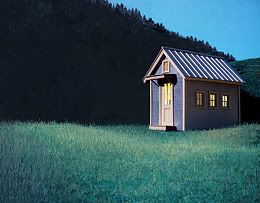
Purchasing a smaller home is one of the many ways to help save the environment, and at the moment, Ryan and I are living in it. But our future goals have us buying a much larger one. In this day and age there are many energy saving products we can buy, so hopefully by the time we build or buy our larger home we will still be doing our part.
Giving credit to TIME, I'd like to thank them for showing us the many ways we can meet these goals of saving our environment. And yes, even one person can make a difference, and it starts with YOU! - Peter aka Blade7184
6. Ditch the Mansion
Oversize houses aren't just architecturally offensive; they also generally require more energy to heat and cool than smaller ones, even with efficient appliances. And in the U.S., big houses are becoming the norm, even though a relatively inefficient small house consumes less energy than a greener large house and uses fewer building materials, which expand the carbon footprint. A typical new single-family home in the U.S. is nearly 2,500 square feet today, up from about 1,000 square feet in 1950, even as the average household has shrunk from 3.4 to 2.6 people.
If you really want to live small, visit Jay Shafer. The former art professor dwells alone in a home fit for a hobbit, 100 sq. ft. in northern California that he designed and built himself in 1999. Shafer now runs Tumbleweed Tiny House and sells custom designs for miniature dwellings that range from 70 sq. ft. to 350 sq. ft. He made his move because he felt guilty about the size of his residential carbon footprint, and now prefers life tiny and tidy. "If I throw my jeans down on the floor, I can't get across the room."
Make sure to follow Blade 7184 every Tuesday for a new issue of Things We Can Do To Save The Environment. Each issue is thought-provoking, informative and may hold the key to saving your children and grandchildren's future
I have organized my blogs with 3 days worth of postings, so if you wish to continue reading the days before that, and so forth and so forth, you can click the "Older Posts" button /\ /\ /\ right /\ up there.
There are 3 other ways you can find interesting topics to read as well.
*Clicking on any of the links under my "Favorite Categories" section on the left hand side of your screen
*Using the Google Search bar under the scrolling text.
*By choosing a date from the drop down list on the right hand side of your screen.
Hope you enjoy my daily posts, and hope to hear from you soon.
- Blade 7184 aka Peter



