Whenever Ryan and I buy an appliance or something new for our home that requires the use of electricity, we look at those yellow stickers that say "EnergyGuide". I'm sure you've seen them. And while the prices may often be a little steep, the end result is a lower bill. And who doesn't want to save money and help the environment at the same time?
ENERGY STAR is a U.S. Environmental Protection Agency voluntary program
that helps businesses and individuals save money and protect our climate
through superior energy efficiency.
Learn more about ENERGY STAR.
Giving credit to TIME,
I'd like to thank them for showing us the many ways we can help
save the environment. Just one person can make a difference,
and
it starts with YOU!
~ Peter aka Blade7184
20. Check the Label
You wouldn't buy a car without knowing its gas mileage. Why not do the
same when choosing energy-efficient ovens or even supermarkets and
hotels? Energy Star, a rating system by the Environmental Protection
Agency, will help you find them. Approved products can be pricier, but
they cost less to power. Commercial buildings account for nearly 18% of
U.S. greenhouse-gas emissions, but those with the Energy Star label
consume 35% less energy than the average. By using Energy Star
appliances at home, consumers can reduce their utility bill as much as
30%.
 Make sure to follow Blade 7184 every Tuesday for a new issue of Things We Can Do To Save The Environment. Each issue is thought-provoking, informative and may hold the key to saving your children and grand-children's future. Please feel free to click on my logo to read previous issues.
 |
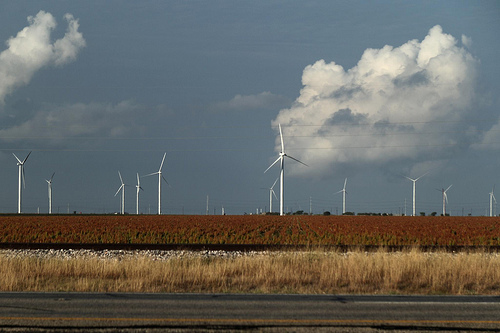
| pic from a farm near my parent's home |
I
didn't know we could opt to buy green power; I guess I'll have to look at our
bill to see where our energy is coming from.
Every time we go visit my parents down in Corpus Christi, TX, we see wind farms as far as the eye can see, and this is something I never would have pictured growing up. What's ironic about the whole thing is... that the power generated by these farms are helping cities hundreds of miles away, and not necessarily the local community.
Giving credit to TIME,
I'd like to thank them for showing us the many ways we can help
save the environment. Just one person can make a difference,
and
it starts with YOU!
~ Peter aka Blade7184
19. Buy Green Power, At Home or Away
More than 600 utilities in 37 states offer green energy, but unless you
read the fine print on your bill, you may not know if your power company
is one of them. (To find out, visit eere.energy.gov/greenpower.)
If you don't live in a green power zone, you can support the industry
by buying renewable energy certificates, which allow you to purchase
green energy in another part of the country. The extra dollars will
dispense green power to the national power grid.
Make sure to follow Blade 7184 every Tuesday for a new issue of Things We Can Do To Save The Environment. Each issue is thought-provoking, informative and may hold the key to saving your children and grand-children's future. Please feel free to click on my logo to read previous issues.
So what do you think would happen if you touched an electrical fence without any shoes on? Yeah - my thoughts exactly.
These five fools thought it would be cool to try a little experiment...
Each person is standing on some type of stool with their shoes on, with the first person holding onto an electrical fence. They each hold hands as another friend comes up to them, removes his shoes, and without any socks or stool for that matter, reaches for the hand of the 4th person in line. Are people really this stupid? Really?
The Global Warming Survival Guide
Reducing carbon emissions around the world is one of the many "Things We Can Do To Save The Environment". Giving credit to TIME, I'd like to thank them for showing us the many ways we can meet these goals of saving our environment. And yes, even one person can make a difference, and it starts with YOU! - Peter aka Blade7184
5. Pay the Carbon Tax
Everyone agrees that it's necessary to reduce carbon emissions around the world. There is less agreement over exactly how nations should go about achieving a more carbon-free planet. Hence, the environmental equivalent of Elvis vs. the Beatles: cap-and-trade carbon emissions, or impose a carbon tax on all users? With cap-and-trade programs, governments limit the level of carbon that can be emitted by an industry. Companies that hold their emissions below the cap can sell their remaining allowance on a carbon market, while companies that exceed their limit must purchase credits on that market. Carbon taxes are more straightforward: a set tax rate is placed on the consumption of carbon in any form—fossil-fuel electricity, gasoline—with the idea that raising the price will encourage industries and individuals to consume less.
At the moment, cap-and-trade has the upper hand, since it serves as the backbone of the current Kyoto Protocol, and helped the U.S. reduce acid rain in the 1990s—but don't write off the tax just yet. Supporters of the tax argue that a cap-and-trade system, especially one that would be global enough to mitigate the 8 billion tons of carbon the world now emits, would be too difficult to administer—and too easily gamed by industries looking to sidestep emissions caps. Cap-and-trade advocates counter that like all other flat taxes, a carbon levy would disproportionately burden lower-income families, who spend a greater percentage of their income on energy than rich households.
So which system will have the largest impact on carbon consumption? A 10% flat carbon tax might reduce the demand for carbon about 5% or less, according to an analysis by the Carbon Tax Center, an environmental advocacy group. That may not be enough. Businesses and governments haven't figured out how the two competing regimes can work together, but in the end, the world may need both.
Make sure to follow Blade 7184 every Tuesday for a new issue of Things We Can Do To Save The Environment. Each issue is thought-provoking, informative and may hold the key to saving your children and grandchildren's future
Woo hoo! Only one poster left after this one. This is the 19th poster and 19th week out 20 that I've been posting them.
Every week I have been blogging about the posters designed by Toby Ng, where he took statistics based on the spread of the population in the world today and translated those statistics into a town of 100 people. So you'd ask yourself, "What if the world were a village of 100 people?" And these posters would answer that question in a much more simpler way.
In my humble opinion I think these posters would be a great educational tool. Great to share with your kids or a classroom.
If you missed any of the previous issues, click here.
I have organized my blogs with 3 days worth of postings, so if you wish to continue reading the days before that, and so forth and so forth, you can click the "Older Posts" button /\ /\ /\ right /\ up there.
There are 3 other ways you can find interesting topics to read as well.
*Clicking on any of the links under my "Favorite Categories" section on the left hand side of your screen
*Using the Google Search bar under the scrolling text.
*By choosing a date from the drop down list on the right hand side of your screen.
Hope you enjoy my daily posts, and hope to hear from you soon.
- Blade 7184 aka Peter